
Tree Removal
Tree removal is the full takedown of a tree, from the canopy down to the stump.
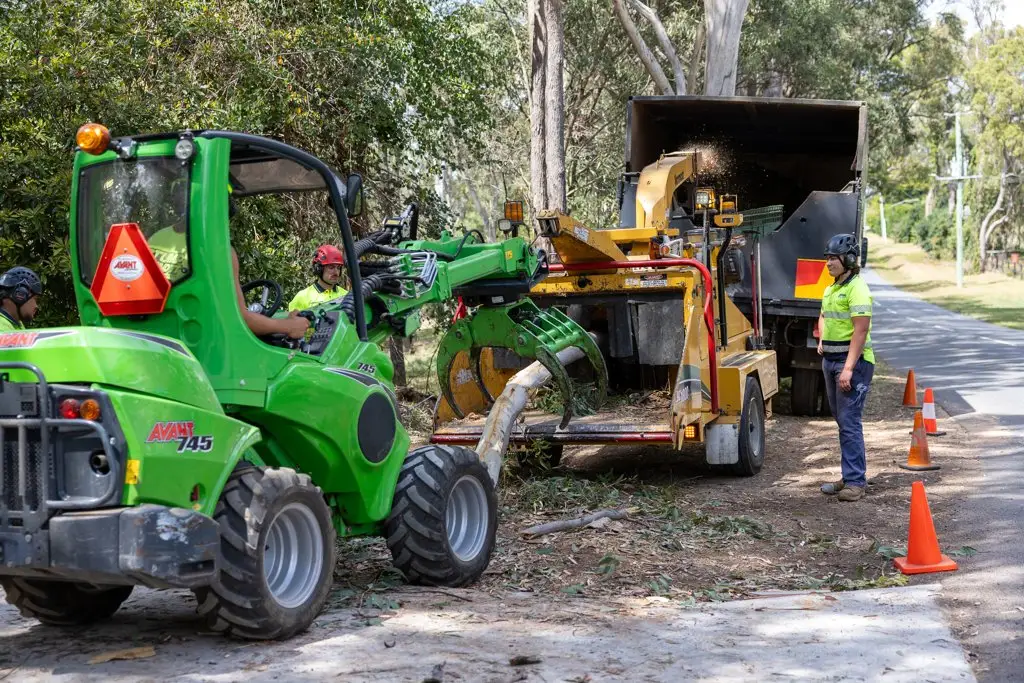
What tree removal means, and who calls us for it
Tree removal is the whole tree out. Canopy, limbs, trunk, down to a low stump. It's a different job to pruning, where the tree stays and we take weight, height or clearance off it. Once a removal is done there's nothing left to manage.
Most calls land in one of a few groups. The tree is dead or heading that way. It's split or half down after a storm. The lean has changed and the ground at the base has moved with it. Roots have lifted a driveway slab or found a sewer line. Limbs hang over the roof and drop timber every summer. Or the tree sits exactly where a pool, shed, extension or new build has to go.
We cover most of Brisbane and a good stretch either side. A lot of the work is in the older suburbs, where the trees went in decades ago and the houses grew up around them. Big gums on sloping blocks through Chapel Hill and Kenmore. Figs and poincianas with room to spread near St Lucia. Tight side access, steep driveways and a neighbour's carport three metres away in Camp Hill. Bigger blocks with room for machinery around Carindale and Upper Mount Gravatt, plus a steady run of tree removal across Brisbane.
Around half our work comes from body corporates, strata managers and property managers. Common property trees carry a different set of problems. Residents to notify, visitor parking to keep clear, committee approval to line up, and paperwork that has to stand up at the next AGM. We've done that work since the business started, so we know what a strata manager needs in the file before the invoice gets paid.
Homeowners get the same process with less paperwork. Same crew, same gear, same clean-up.
What you're seeing, and what's usually behind it
Trees rarely fail out of nowhere. The signs sit there for a year or two first. They're just hard to read from the back deck.
Here's what customers notice before they ring us:
- Bare limbs in the middle of summer, or a canopy that thins a little more every year.
- Brackets, mushrooms or crusty growth at the base of the trunk or on a surface root.
- Bark lifting off in sheets with dry, crumbly wood underneath.
- A lean that's steeper than it was, with cracked or humped soil on the opposite side.
- A split in a main fork, usually after a storm, sometimes with water sitting in it.
- Thick clumps of new shoots straight off the trunk after a heavy lopping years back.
- A hollow knock when you tap the trunk, or a cavity you can get an arm into.
- Roots lifting a path, a driveway or the coping around a pool.
- Termite mud running up the trunk.
The causes behind all that are pretty ordinary.
Storm season does a lot of it. From November through to March we get sodden ground and strong gusts on the same afternoon. Wet soil won't hold a root plate. Trees that stood for forty years go over in twenty minutes, and the ones that stay up often lose a major limb instead.
Then there's age and planting position. Plenty of the trees we remove went in between the 1960s and the 1980s, back when the house was new and the sapling looked harmless. A tree planted two metres off a wall now wants eight metres of room. Nobody did anything wrong. The tree just finished growing.
Root damage from earlier work is the quiet one. Pools, new driveways, retaining walls, plumbing trenches and shed slabs all cut roots. The tree can look fine for two or three summers and then drop away fast. By the time the canopy thins, the damage is years old and there's nothing left to undo.
Old lopping causes its share too. Topping cuts leave wide wounds that decay from the inside out. The regrowth attaches to the outer shell of sound wood, so it ends up heavy, upright and poorly held on. That's the timber that lands on a roof in a summer storm.
Species and site matter as well. Cocos palms self-seed along fence lines and get ignored until they're over the neighbour's shed. Camphor laurels grow fast and push roots into old clay pipes. Liquidambars lift paths and driveways. Big eucalypts shed limbs in hot weather as normal behaviour, not as a fault. Shallow soil over rock on the ridges, reactive clay on the flats and slope on the western blocks all change how well a tree holds on when it blows.
One more thing worth saying. Not every tree we look at has to come out. Sometimes a crown reduction, a dead-wood and a clean-up buy another ten years, and we'll tell you that at the quote even though it's a smaller job for us.
How we run a removal, first call to final rake
First call. Bianca takes the details in the office: the address, what the tree is doing, how urgent it feels and when you're around. Photos help, especially of the side access and the gate width. If it's strata or a rental, we take the manager's details and the site contact as well.
The site quote. One of our arborists comes out and looks at the tree properly, not from the kerb. Height, spread, species, condition of the trunk and the roots. What sits under the drop zone: roof, fence, pool, shed, garden beds, the neighbour's carport. Where the truck and chipper can park. Whether an EWP (an elevating work platform, the cherry picker) can get in, or whether the tree has to be climbed. Where the waste goes and how far it has to be carried out. Those four things, size, access, targets and waste, are what set the price. It's also why we don't quote sight unseen.
The written quote. You get it in writing with the inclusions spelled out. Stump grinding sits as its own line, because it's a separate machine and a separate part of the day. If you want mulch left for the garden or rounds cut for firewood, that goes on the quote too. The price is agreed before anyone starts. If something changes on site, we stop and ring you rather than add it on later.
Checks and approvals. Some trees are protected. Brisbane City Council's natural assets local law, vegetation protection orders and conditions written into a title can all apply, and the rules aren't the same in every street. We check before we cut. If an application is needed we'll explain what's involved and roughly how long it takes. Taking out a protected tree without approval can cost far more than the tree ever did.
Notices and arrangements. Neighbours hear from us if we need to work over the boundary or set up in their driveway. Strata gets a notice for the board and the residents' group so nobody parks under the drop zone on the day. If the tree sits inside the exclusion zone for overhead power, we organise an authorised line crew or an isolation first. That gets sorted at quote stage, not on the morning while everyone waits.
Set up on the day. The crew arrives at the agreed time with the truck, the chipper and the climbing gear. Cones and signage go out if we're near the footpath or the road. Boards and mats go over soft lawn and garden beds where timber will land. The crew runs a toolbox talk on the tree, the drop zones and who is doing what, then sets an exclusion zone that nobody walks into. Kids and pets inside, please.
The takedown. The climber ropes in, or the EWP goes up. Limbs come off in sections and get lowered on rigging ropes through a friction device rather than dropped. It's slower. It's also the reason your fence, your roof and your camellias are still there at five o'clock. The ground crew keep the drop zone clear and feed the chipper as the sections come down, so the yard never fills up with timber. The trunk gets taken in pieces from the top.
The stump. A standard removal leaves the stump cut as low as the gear safely allows. Grinding is the separate job. If it's on the quote we bring the grinder in, agree the depth with you first, chase the surface roots if you're re-turfing or building, then backfill with the grindings or cart them off.
Clean-up and sign-off. We rake, blow and sweep, including the footpath and the road. Mulch stays if you asked for it. Before the truck leaves, someone walks the site with you so anything you're not happy with gets fixed while we're still there. For strata and property managers, the invoice goes through with the job details and photos so the manager has something to file.
The gear we bring and the standards we work to
Removal work is gear-heavy. The right machine on site is the difference between a long, noisy day and a clean one.
The EWP is a bucket on a boom that lifts an arborist up to the work. It's quicker and safer than climbing a dead or storm-damaged tree, where the wood can't be trusted to hold a climber's weight. It also lets us reach over a fence or a pool without rigging half the job. Some blocks are too steep or too tight for it. That's when the tree gets climbed instead, and our climbers use spurs only on trees coming out, never on a tree that's staying.
Rigging gear is what keeps big timber off your house. Lowering devices, blocks, slings and ropes, all rated with a working load limit, all inspected before use and retired when they're worn. Chainsaws come in a few sizes for a reason, from a small top-handle saw up in the canopy to the big bar for the butt. The chipper and tipper truck handle waste on site, so nothing sits on your lawn overnight. Stump grinders come in narrow models that fit through a standard side gate.
On standards, here's where we sit. Pruning on trees that stay follows AS 4373-2007, Pruning of amenity trees. Where a removal happens next to trees being kept, especially on building sites, tree protection zones come from AS 4970-2009. Removal work itself runs to Safe Work Australia's guidance for tree trimming and removal work, which is where drop zone planning, exclusion zones and the site risk assessment come from. EWP operation follows AS 2550.10 for safe use. PPE is to the Australian standards for helmets, eye and hearing protection and chainsaw-rated leg protection, and the crew wears the lot whether anyone's watching or not.
Power lines get their own rules. Queensland sets legal exclusion zones around overhead lines, and untrained people, tools and falling limbs all have to stay outside them. We don't work inside those zones without an authorised line crew or the power isolated. We'll tell you at the quote if your tree is one of those jobs.
Paperwork comes with the job when it's needed: a site-specific risk assessment, a safe work method statement, and traffic control where we're working off the road. Builders and strata managers can ask the office for what they need before the work day and we'll send it through.
Storm damage and urgent removals
We're not a 24-hour call centre and we won't pretend to be. The phone gets answered in business hours. After a big blow the crews start early and work the list until dark.
First thing, before you ring us. If a tree is on a power line, or a line is down in the yard, stay well clear and call Energex or 000. If the tree is on the house and people are inside, that's a 000 call too. Then get on to us.
When you do call, tell us what's moved. What's fallen, what it's resting on, whether anyone's blocked in, whether power or water is affected. A photo helps if it's safe to take one from a distance. That's usually enough for us to work out whether it's a make-safe today or a booked removal later in the week.
Make safe comes first. That might mean cutting a limb off the roof, taking the weight out of a branch hung up in the canopy, or getting a half-fallen tree on the ground and away from the driveway. The full removal gets booked once nobody's at risk and we can plan it properly. Rushing a big tree in the dark helps no one.
Our order after a storm is simple: risk to people first, then buildings, then blocked access, then everything else. Every phone in Brisbane rings at once after a bad night, so we'll tell you straight where you sit in the run rather than promise a time we can't hit. If you're making an insurance claim, say so when you book. We'll put what we found and what we did in writing, with photos, which is usually what the assessor asks for.
Why people book the Acclaim crew
Our Google reviews keep saying the same thing. Read a few and the same word keeps turning up: professional. That's the one we care about, because it covers turning up when we said we would, following the plan and doing the paperwork.
We're family run, with qualified arborists, trained staff and ongoing training for the crew. The business started in the Kenmore area and grew on body corporate, strata, residential and commercial jobs, which is still the mix today.
A few things we hold to on every removal:
- The price is upfront and agreed before a saw starts. Size, access, targets and waste drive it, and the quote says what's in and what isn't.
- We check the rules before we cut. Council, protected vegetation, neighbour notice. That's what separates an arborist from a lopping crew.
- Big limbs get rigged down in sections rather than dropped. Fences, gardens, pipes and parked cars all get worked around.
- Clean-up is part of the job, not an extra.
- Neighbours and passing traffic get thought about before the day, not apologised to afterwards.
Got a tree that needs to come out, or you're not sure whether it does? Call the crew on 0421 484 940 and we'll book a site visit. Quotes are done in person, on your block, before anything gets cut. acclaimtreecare.com.au
Frequently asked questions
What does tree removal cost?
It comes down to the tree's size, how close it is to buildings, whether machinery can get in, and how much waste we cart out. We don't quote sight unseen. Call us on 0421 484 940 and we'll book a site visit, then you get the price upfront before anyone starts.
Do I need council approval to remove a tree?
Sometimes. Some trees are protected vegetation and some blocks have conditions written into the title. We check before we cut. If an application is needed we'll explain what's involved and what the process looks like. Removing a protected tree without approval can land you a fine, so the check is worth it.
Is the stump included in the price?
Not automatically. A standard removal takes the tree down to a low stump. Stump grinding is a separate part of the job with its own machine. Tell us when you book if you want the stump gone and we'll put it in the quote rather than surprise you later.
What happens to all the timber and mulch?
It goes through the chipper and off site in our truck, unless you want some kept. Plenty of customers ask us to leave mulch for the garden or cut rounds for firewood. Just say so on the day. Clean-up is part of the job, not an extra.
What if the tree is near power lines?
We'll tell you at the quote. Work close to live lines needs an authorised line crew or the power isolated, and that gets organised before the work day. It isn't something we sort out on the spot. We make the arrangement clear from the start so there are no hold-ups.
How long does a tree removal take?
Most single trees are a one-day job. Big removals or tight access can run to two days, and stump grinding sometimes comes back as a second visit with the right machine. We'll give you a realistic timeframe at the quote, not a guess.
What if there's no machine access down the side of the house?
It happens a lot on older blocks. The tree gets climbed instead of using the EWP, and the timber is carried or barrowed out to the truck. Our narrow stump grinder fits through a standard side gate. Access does affect the price, so we look at it at the quote.
Do you work with body corporates and strata managers?
Yes, that's a big part of what we do. We handle resident notices, parking and access arrangements, traffic control where needed, and the site paperwork managers have to file. Invoices come through with job details and photos. Call 0421 484 940 and ask for a site inspection.
Ready to get started?
4.9 from 114 Google reviews. Fully Insured.