
Tree Felling
Tree felling is the removal of a whole tree, from the canopy down to the stump.
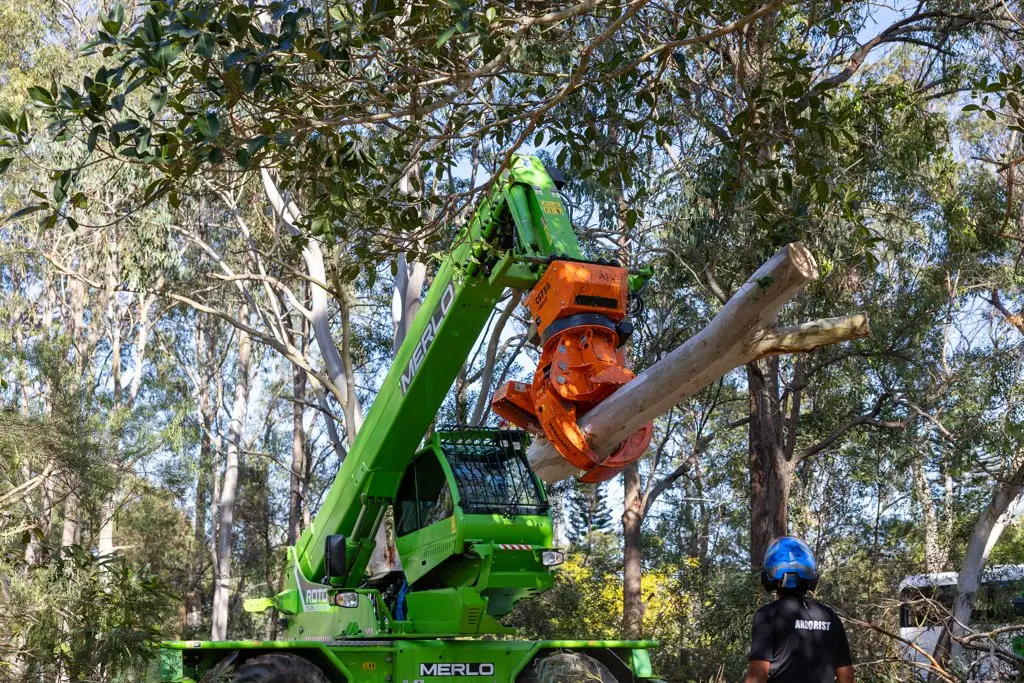
What tree felling is, and who calls us for it
Tree felling is the removal of a whole tree: canopy, limbs and trunk, down to a low stump. Pruning keeps the tree and shapes it. Felling ends it. That's a one-way decision, so we don't push it. If a crown reduction, a crown lift or some dead-wooding will fix the problem, we'll quote that instead and tell you why.
Most felling calls start one of a few ways. A big gum has dropped a limb across the carport. A camphor laurel is lifting the driveway and pushing the retaining wall over. A poinciana leans over the neighbour's roof after a wet summer. A builder needs the pad clear before the slab goes in. Or the tree is plainly dead and the bark is coming off in sheets.
We work across most of Greater Brisbane. Blocks around here are rarely simple. Queenslanders on stumps with a metre of clearance down the side. Post-war brick and tile with a pool and a shared fence. New builds pushed hard to the boundary on an old split lot. Strata complexes where residents park exactly where the truck needs to sit.
So access is the first thing our crew looks at. Before size, before species, before anything else. On a tight block we climb and rig the tree down in sections, with ropes taking the weight so nothing lands on the roof. Where there's room to work we bring in an EWP (an elevating work platform, what most people call a cherry picker), or fell the trunk in one controlled drop.
We fell trees for homeowners, body corporates, strata managers, builders and commercial sites. The strata side is where this business was built, back when it started out around Kenmore, and it's still a big part of most weeks. Committees get a written scope, notice for residents, and a crew that keeps the driveway usable.
One thing always happens before the quote: we check whether the tree is protected. Brisbane City Council protects a lot of vegetation, and plenty of titles carry their own conditions. More on that below.
What you're seeing, and what's actually going on
Most people don't ring about a tree. They ring about what the tree is doing.
Dead wood is the usual one. Grey limbs sticking out above the green, bark shedding in sheets, mushrooms or hard brackets at the base. Brackets low on the trunk generally mean decay inside, and decay inside a trunk is a structural problem rather than a cosmetic one. A gum can look healthy from the footpath and be hollow through the butt.
Lean is the next. Trees lean their whole lives without falling over, so the question is whether the lean is new. Cracked soil on the high side. Lifted turf. A mound of dirt at the base, or roots showing where they weren't showing last year. Those say the root plate is moving. Three wet weeks in clay and that's a call to make quickly.
Then there's what the tree is doing to the house. Roots in the sewer line. Gutters full every fortnight. Branches rubbing tiles loose. A driveway slab lifted 40 millimetres by one surface root. Fig, camphor laurel and poinciana roots travel a long way for water, and old Brisbane sewer joints are easy feeding.
Why so often, and why here? The same reasons keep coming up.
- Planting distance. Plenty of the big trees on Brisbane blocks went in during the 60s and 70s, two metres off the house, when they were knee high. Nobody pictured 20 metres of camphor laurel.
- Clay and a wet summer. Brisbane soil holds water, then a storm loads the canopy like a sail. Root plates let go in saturated ground far more easily than in dry.
- Storm loading. Summer southerlies arrive hard and fast. Codominant stems with tight included bark are the ones that split, and half a poinciana takes out a fence and a car in a second.
- Old root damage. Pool digs, service trenches, retaining walls and slab extensions cut roots the tree never gets back. It looks fine for five or six years. Then it doesn't.
- Past topping. A tree butchered by a lopping crew years ago carries heavy regrowth attached to little more than bark. Those shoots tear out under load. We see it on the older frontages around Tarragindi.
- Species that outgrew the block. Cocos palms planted as a screen. Chinese elm suckering through the fence line. An umbrella tree in the retaining wall.
None of that automatically means the tree comes out. A reduction can keep the tree going. Sometimes the better answer is removal, then something planted that actually suits the block. We'll tell you which one we'd do, and put it in writing.
How a felling job runs, from your first call to a clean site
The call
Bianca takes most of them. She'll want the address, what the tree is, what's worrying you, and how close it sits to the house, the fence and any power lines. Photos help a lot. Send a couple through and we often know the shape of the job before anyone drives out.
The site check
For anything beyond a small tree, one of us comes and looks. We walk the access route, measure the drop zone, check the ground for soft spots a truck can't cross, read the tree's structure, then decide whether it's a climb-and-rig job or an EWP job. On a steep back yard in Chapel Hill with no vehicle access, the answer is climbers, ropes and a fair bit of carrying. On a flat verge in Eight Mile Plains it might be the EWP and the chipper on the kerb.
The protected vegetation check
We check the council position on your tree and your block before we quote. Brisbane City Council protects a lot of vegetation through its planning scheme, and some properties carry a Vegetation Protection Order or conditions on the title. Neighbouring councils run their own rules. If an application is needed we'll explain it. We won't cut a protected tree until the paperwork is sorted, and we won't quote a job on the hope that nobody notices.
The written quote
Scope in writing: which trees, how far down, what happens to the timber and the chip, and what the price doesn't include. Stump grinding is a separate machine, so it's a separate line on the quote. What moves the number is size, how close the tree sits to buildings and lines, how we get gear in, and how much waste leaves the site. A steep back yard takes far longer than a clear front lawn. Ring 0421 484 940 and we'll arrange a look.
Planning and notice
Once you accept, we lock in a date and sort what needs sorting. That can mean written notice to neighbours, a note for the strata noticeboard, a permit for the truck, traffic control if we're working off the road, or contact with the electricity network where the tree sits in the lines. Committees get a start time to pass on to residents. Nobody should wake up to a chipper they knew nothing about.
Work day
The crew arrives, walks the site with you, then sets up the exclusion zone. Climber goes up, or the EWP goes in. Limbs come off and get lowered on ropes where there's a roof, a pool or a garden bed underneath, and get dropped where there's space to drop them. The trunk comes down in sections or in one piece. Brush goes through the chipper as it comes off, so the yard never fills up.
Clean-up
The mess leaves with us. Timber gets cut and loaded, brush gets chipped, then we rake and blow the area down before anyone packs up. Want the mulch on your garden beds, or the trunk cut into firewood lengths? Say so on the day and we'll stack it where you point.
After
If you've booked stump grinding, it happens in the same visit or on a return visit, depending on the machine and the access. Property managers who need a completion record or documentation for the committee can ask Bianca, and we'll send through what your paperwork requires.
Gear, tickets and the standards we work to
Felling is the part of arboriculture that hurts people when it's done casually. The gear and the rules are the difference.
Climbing and rigging. Our climbers work on rope systems, with harnesses and fall protection to AS/NZS 1891. Limbs come down on rigging rope through a lowering device at the base, with a groundie on the rope controlling the descent. Blocks, slings and rope all carry rated working loads, and we rig to those rather than to what feels about right. That's how a heavy limb gets past a tiled roof in one piece.
EWP work. An elevating work platform does the job faster where the ground allows it. EWPs are operated under AS 2550.10, the safe use standard for mobile elevating work platforms, with pre-start checks and a machine logbook. In Queensland a boom over 11 metres also needs a high risk work licence to operate. That's a fair question to ask any crew before they set up on your driveway.
Chainsaws and PPE. The crew wear helmets to AS/NZS 1801, eye protection to AS/NZS 1337, hearing protection to AS/NZS 1270 and chainsaw trousers or chaps to AS/NZS 4453. Hi-vis near traffic. None of it is for show. A saw chain moves quicker than anyone's reflexes.
Chippers. The chipper catches people out more than the saws do. Feed rollers, a control bar within reach at all times, no loose clothing, no reaching past the feed tray. Only trained crew feed it, and nobody feeds it alone.
Power lines. Queensland's electrical safety rules set minimum approach distances around overhead lines, and those distances apply to the saw, the rope and the branch, not only to the person. Work inside them has to go to an authorised line-clearance crew. If your tree falls in that category we'll say so at the quote, not halfway through the job. Where we can work safely to the required clearances, we will.
Traffic. Working off the road means cones, signs and a traffic guidance plan based on the Queensland manual of uniform traffic control devices. On the busier streets around Carindale, that's most of the reason a job starts early.
Pruning standard. Anything we leave standing gets cut to AS 4373, the Australian standard for pruning amenity trees. Where trees are kept on a development site, AS 4970 covers tree protection zones and what's allowed inside them. That matters when you're felling one tree and keeping the one beside it.
Ask us for documentation before the crew arrives. Strata managers do, every time, and we'd rather send it up front than argue about it later.
Storm damage and urgent calls
Brisbane storms don't book ahead. A limb through the roof at 6pm on a Sunday is a different job to a planned removal, and it gets handled differently.
Safety first, and this part isn't us. If a tree is on the house with people inside, or across a road, ring 000. If a power line is down or a tree is in the wires, ring Energex on 13 19 62 and stay well clear, including of the ground nearby. For storm damage to a building, the SES is on 132 500. We can't touch a tree in live wires, and neither can anyone else without the right authority.
Once the site is safe, ring us on 0421 484 940. We're a working crew, not a 24 hour call centre, and we'd rather be honest about that than promise a truck at midnight. In business hours you'll get Bianca or one of the team. Outside them, leave a message with the address and what's happened, and we'll come back to you as soon as we can.
Urgent jobs usually run in two parts. First the make-safe: get the hanging limb out of the tree, take the weight off the roof or the fence, clear the driveway so cars can move. That can be a couple of hours' work. Then the full removal and clean-up, booked in once the insurer, the strata manager or the builder has what they need. Take photos before we start if you're making a claim. Insurers ask for them, and we can't recreate them once the tree is in the truck.
Storm season runs from about November to March. The call we'd rather get is the one in August, while the dead limb is still just a dead limb.
Why people book Acclaim Tree Care
Our Google reviews keep saying the same thing. The word customers use most is professional. Careful comes up nearly as often, usually about the garden beds and the neighbour's fence.
A few specifics worth knowing.
Qualified arborists on the crew. Troy Moncur owns and runs it, the business is family-run, and training is ongoing rather than something that happened once years ago.
Body corporate and strata work is the backbone of the business. It grew up on that work. We know what a committee needs before it can approve a removal, and we know residents notice a blocked driveway faster than they notice a tree.
Council comes first. Protected vegetation, Vegetation Protection Orders, conditions on the title. It's the step a lopping crew skips, and the one that costs owners the most when it goes wrong.
Upfront on scope and on price. You'll know what's in the quote and what isn't, stump included or not. No extras appearing on the invoice.
Clean-up matters as much as the cut. Chipper, rake, blower, then we're gone.
Respect for the street. Neighbours get told. Traffic gets managed. Gear doesn't sit on your footpath overnight.
If you've got a tree that needs to come out, anywhere in Greater Brisbane, including St Lucia, ring 0421 484 940 and we'll arrange a site check and a written quote.
Frequently asked questions
Do I need council approval to fell a tree?
Often, yes. Brisbane and the surrounding councils protect a lot of vegetation, and some blocks carry extra conditions on the title or a Vegetation Protection Order. We check before we quote and tell you what's needed. If an application is required, we'll explain the process. We don't cut protected trees until the paperwork is sorted.
What does tree felling cost?
It depends on the size of the tree, how close it is to buildings and power lines, how we get gear in, and how much waste comes out. A steep back yard with no vehicle access takes far longer than a clear front lawn. Ring 0421 484 940 and we'll arrange a look and a written quote.
Is the stump included?
No. We cut the tree down to a low stump as part of felling. Grinding the stump out is a separate machine and a separate line on the quote. Tell us when you call if you want it gone and we'll price both together.
What if the tree is near power lines?
We stop and plan. Some work near lines has to be done by an authorised line crew, and we'll say so from the start rather than halfway through the job. Where we can work safely to the required clearances, we will. Either way you'll know before the crew arrives.
What happens to the mess?
It leaves with us. Branches go through the chipper, timber is cut and loaded, and we rake and blow the area down before we go. Want the mulch or the firewood kept on site? Say so on the day and we'll stack it where you point.
Can you fell a tree in a back yard with no truck access?
Yes, that's most of our work. The climber goes up with ropes and rigging gear, limbs come down in controlled sections, and the timber and brush get carried or barrowed out to the street. It takes longer than a front yard job, so we factor that into the quote after the site check.
How long does a felling take?
A straightforward tree with clear access can be done in a few hours. A large gum rigged down over a roof, a pool and a neighbour's fence can run a full day or more. We give you a realistic time frame with the quote, plus a start time so you can move cars and tell the neighbours.
The tree is on the boundary. Whose is it?
Ownership generally follows where the trunk sits at ground level, so a boundary tree can be shared. Get the neighbour's agreement in writing before the work goes ahead, and check the council rules as well. We're happy to talk the job through with both households so everyone knows what's happening on the day.
Ready to get started?
4.9 from 114 Google reviews. Fully Insured.