
EWP
An EWP is an elevating work platform, the cherry picker style machine that lifts an arborist up to the canopy in a basket.
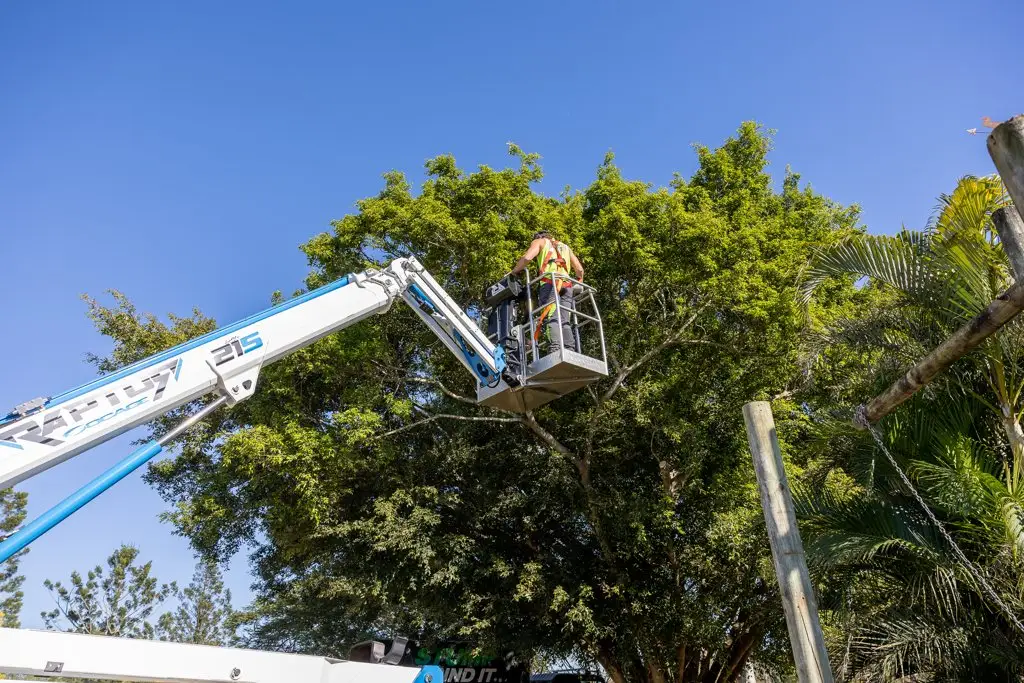
What an EWP is, and who it suits
An EWP is an elevating work platform. Most people call it a cherry picker. It's a boom on a truck or on a set of rubber tracks, with a basket on the end that lifts a qualified arborist straight up to the canopy.
We bring one when climbing isn't the safest or the tidiest way into a tree.
A climber needs sound wood. The rope gets anchored high in the crown, and that anchor has to hold a person plus the shock load of a limb swinging on a rope. Dead wood, rot in a branch union, a fresh split from a storm or a heavy lean all take that option away. The basket carries the weight instead. The tree only has to hold itself up while we take it apart.
There's a second reason, and it's about what happens on the ground. A basket puts the arborist beside the cut at the right angle, every time. The cuts are controlled. Pieces come down short and go straight into the chipper. That counts for a lot when the tree sits hard against a roof line, a boundary fence, a carport or a driveway that four other units need to use that morning.
The work suits three groups of customers.
Homeowners with a tall gum, an old fig or a row of palms that got away from them. Body corporates with common property trees hanging over visitor parking and shared paths. Property managers who want a big prune or a removal done between tenancies, without the block shut down for a week.
We work across Greater Brisbane, including the western suburbs. A tracked lift squeezed down the side of a post-war home in Taringa and a truck-mounted boom set up in a unit carpark at Upper Mount Gravatt are both a normal Tuesday.
Before anything gets booked we check access, set-up space, ground conditions and what's overhead, power lines included. You'll know the plan, the likely time on site and what the machine can't reach. That last one matters. Some trees still need a climber for the final few metres, and we'd rather say so at the quote than on the day.
What you're seeing, and what's behind it
Nobody rings us about an EWP. They ring about a problem, and the machine is the answer to it.
Here's what people describe on the phone:
- Dead limbs standing grey and bare in the top of a gum.
- A branch that let go on a hot, still afternoon with no wind to blame.
- A tree leaning further than it was last winter.
- Dead fronds and seed pods dropping off palms onto a carpark, pool fence or shared path.
- Mushrooms or a shelf of fungus at the base of the trunk.
- A canopy sitting on the gutters and filling the box gutter of a unit block with leaf.
- Storm damage: a split fork, a hanger caught up in the crown, half a crown gone.
Most of it traces back to a handful of causes.
Age and size. Big parts of the western and southern suburbs were built out and planted decades ago. The gums, figs, camphor laurels and poincianas that went in near the back fence are now taller than the houses. Unit blocks from the eighties and nineties have the same story along their boundaries, which is why so much of our EWP work is body corporate work in places like Carindale.
Summer limb drop. Eucalypts shed limbs on hot, calm days, and the branch often looks healthy right up until it goes. Spotted gum and blue gum both do it. There's no wind to warn you.
Old lopping. Topping a tree leaves a stub. The tree answers with a burst of shoots off the outside of that wound. Ten years later those shoots are limbs the size of a small tree, attached to a thin collar of wound wood, sitting over a roof. They're what fails in the first decent storm. It's why we talk about pruning rather than lopping.
Decay you can't see from the ground. Bracket fungi, hollows and soft butt wood mean the structure is going, even when the bark looks fine. That's the exact situation where nobody should be climbing.
Storm season. Brisbane's weather arrives between November and March. Saturated clay soil, then a gust front. Root plates lift on sloping blocks where the soil is thin over rock, or where a retaining wall cut through the root zone years ago. The steep streets around Chapel Hill throw up a lot of that work.
Palms. Cocos, royal and golden cane. Nobody plants a palm expecting 15 metres. Once they're up there, a clean means height, and a palm crown is a poor anchor for a climbing line. Basket work is quicker, safer and doesn't leave spike marks in the trunk.
Power lines. Plenty of older streets still run lines along the rear boundary, and trees planted under them have to be kept clear. That changes the job, and sometimes it changes who is allowed to do it.
How the job runs, from first call to final rake
Nothing about an EWP job should be a surprise on the day. Here's the order it happens in.
It starts with a phone call. You'll get Bianca in the office on 0421 484 940 during business hours. Tell us the tree, the address and what's worrying you. Photos by text or email save everyone a trip.
Then a site check. One of our arborists comes out and looks at two things: the tree, and how we get a machine to it. Gate width, side access, slope, soft lawn, paving that won't take a load, tanks or services under the set-up spot, where the truck and chipper sit, and what's overhead. If the boom has to set up on a neighbour's driveway, we ask them in person and in advance.
Council rules get checked at that same visit. Brisbane protects a lot of vegetation through the Natural Assets Local Law, vegetation protection orders and street tree rules, and other councils in our area have their own. We check before anyone cuts. If your tree is covered, we'll explain the approval path. If it isn't, we'll tell you that too.
The quote comes in writing, tree by tree. Included: the cutting, the rigging, the chipping and the clean-up. Not included: stump grinding is priced separately, work inside a power line exclusion zone goes to an authorised line crew, and anything genuinely out of reach gets named. Three things drive the price, which are size, access and how much waste comes out. Careful set-up isn't an extra. It's in the quote.
Once you accept, we lock in a date and an arrival window. For strata we'll send a notice for the committee and the lobby, and flag the units closest to the work. Cars need to be off the work zone that morning. If we're setting up on the street, permits and traffic control get sorted first.
Work day starts with set-up. Pre-start check on the machine. Toolbox talk through the job plan and the rescue plan. Cones, tape and an exclusion zone under the work. Ground protection and spreader pads under the outriggers where the surface needs it.
Then the tree comes back, or comes down, in sections from the top. Heavy pieces get rigged and lowered on ropes to a groundie rather than dropped. A spotter watches the drop zone the whole time. The chipper keeps running so the site never fills up with timber.
Clean-up matters just as much as the cut. Rake, blow down the paths and driveway, chip everything out. Mulch stays if you want it. Firewood lengths stay if you want those.
Last, we walk the site with you. Photos go to the strata manager or the agent for their file if they need them, and the invoice comes from the office.
Gear, tickets and the standards we work to
The machine gets matched to the tree, not the other way around. Truck-mounted booms handle kerbside and carpark work. Tracked lifts fit through a standard side gate, cross a lawn and spread their weight through outriggers, which is what gets us into tight blocks in suburbs like St Lucia, where the tree is in the back corner and the only way in is a metre wide.
EWPs get a pre-start check every morning, a logbook, an annual inspection and a major inspection at ten years. That's what AS 2550.10, the safe use standard for elevating work platforms, sets out. Boom-type units of 11 metres and over need a high risk work licence to operate. Anyone in the basket is clipped to the anchor point on a fall restraint lanyard, and the ground controls stay manned so the basket can be brought down from below if it ever needs to be.
Pruning follows AS 4373, the Australian standard for pruning amenity trees. In plain terms: cut at the branch collar, no flush cuts, no stubs, no topping. Crown lift, crown thin and crown reduction each mean a specific thing, and we write down which one we're doing so you know what the tree will look like afterwards. Where a builder is working near a tree that's staying, AS 4970 covers tree protection zones on development sites.
Power lines have their own rules. Queensland sets exclusion zones around live overhead lines, and the distance depends on the voltage and on who is doing the work. Anything inside those zones is for an authorised line crew, not a general tree crew. We tell you that at the quote, not on the day the truck turns up.
PPE isn't optional on our sites. Helmets to AS/NZS 1801, eye and face protection, hearing protection to AS/NZS 1270 and chainsaw leg protection to AS/NZS 4453. Rigging runs on arborist-rated ropes, slings and a friction device at the base of the tree. Every truck carries a first aid kit with a trauma dressing, an extinguisher and a written rescue plan for the basket.
Work at height and machinery both sit under the Work Health and Safety Regulation 2011. Our crew is trained for the gear they run, and the training keeps going, because the standards and the machines both move.
Storm damage and urgent jobs
We're a tree crew, not a 24 hour call centre. The office runs business hours on 0421 484 940. If something comes down at 11pm, leave a message or send photos through and we'll pick it up first thing. Being straight about that beats promising a truck at midnight and not turning up.
Make the site safe first:
- If a line is down, or anyone is hurt, ring 000.
- Keep everyone well clear of a fallen line and treat it as live. Report it to Energex.
- A tree on a house or blocking access is an SES job on 132 500.
- Take photos before anything gets cut. Your insurer will want them.
When we get to you, urgent work usually runs in two parts. First a make safe: drop the hanger, take the weight off the roof, clear the driveway so people can get in and out. Then a booked return for the rest of the tree, once the machine, the traffic control or the council approval is sorted.
Storm jobs are where an EWP earns its keep. A split fork or a half-failed crown has nowhere safe to anchor a rope. We work the damaged part from the basket and leave the tree alone until it's safe to touch.
We sort the list by risk. A limb hanging over a childcare fence or a unit block walkway goes ahead of a tree on the back lawn. If we can't get to you, you'll hear that when you ring rather than sitting by the window waiting.
Why people call us for EWP work
Acclaim Tree Care started in Kenmore and grew on body corporate, strata, residential and commercial work. That's still where most of our EWP jobs come from. Committees and property managers keep calling because the notices, the paperwork and the clean-up get handled without them chasing us.
The business is family-run under Troy Moncur, with qualified arborists and trained staff. Bianca answers the phone, so you're talking to someone who knows the job list rather than a booking service.
Our Google reviews are what we point people to. The words that repeat are professional, careful, upfront and tidy.
On an EWP job that looks like this. We check the council rules before we cut. We tell you what we can't reach. We set up to protect your lawn, your paving and your garden beds. And we leave the site cleaner than we found it.
Got a tree that's too big, too dead or too close to the house to climb? Ring the office on 0421 484 940 or book a site check at acclaimtreecare.com.au.
Frequently asked questions
When is an EWP better than a climber?
When the tree isn't safe to climb. Dead wood, storm damage, rot or a heavy lean all mean there's no anchor point a climber can trust. It's also faster on tall palms and on trees sitting tight against a building, because the basket puts the arborist right beside the cut.
What access does the machine need?
A clear path in and firm, reasonably level ground to set up on. Narrow side access, soft lawn, steep blocks and low gates all change the plan, and sometimes they change the machine. That's what the site check sorts out, so there are no surprises on the day.
Will it damage the lawn, paving or garden beds?
We set up to avoid it. Ground protection goes down where needed, spreader pads sit under the outriggers, and the crew works around plants and paving. Tracked lifts spread their weight rather than digging in. Careful set-up is part of the quote, not an extra line at the end.
What about trees near power lines?
We check clearances first. Queensland sets exclusion zones around live overhead lines, and work inside them has to go to an authorised line crew. We'll tell you that upfront rather than on the day. If a permit or council check is needed for protected vegetation, we sort that before any cutting starts.
How much does EWP work cost?
It depends on the tree, the access and how much waste comes out. We quote after a look at the site, so the price is real rather than a guess. Call the office on 0421 484 940 or head to acclaimtreecare.com.au.
Do I need council approval before you can cut?
Sometimes. Brisbane protects a lot of vegetation through the Natural Assets Local Law, vegetation protection orders and street tree rules, and other councils in our area have their own. We check before we quote. If approval is needed we'll explain the path, and if it isn't, we'll tell you that too.
Can you do EWP work at a unit complex without shutting the carpark?
Usually, yes. We work out where the machine sets up, which bays need to stay clear and for how long, then send a notice for the committee and the residents closest to the work. Most jobs only need a small exclusion zone at a time, not the whole carpark.
Do you take the timber away, and what happens to the stump?
Everything gets chipped and taken off site unless you want mulch or firewood lengths left behind. Just say so when we quote. Stump grinding is a separate job and a separate price, so ask for it upfront and we'll put it on the same quote.
Ready to get started?
4.9 from 114 Google reviews. Fully Insured.