
Tree Pruning
Pruning keeps a tree healthy, safe and the right shape for the space it's in.
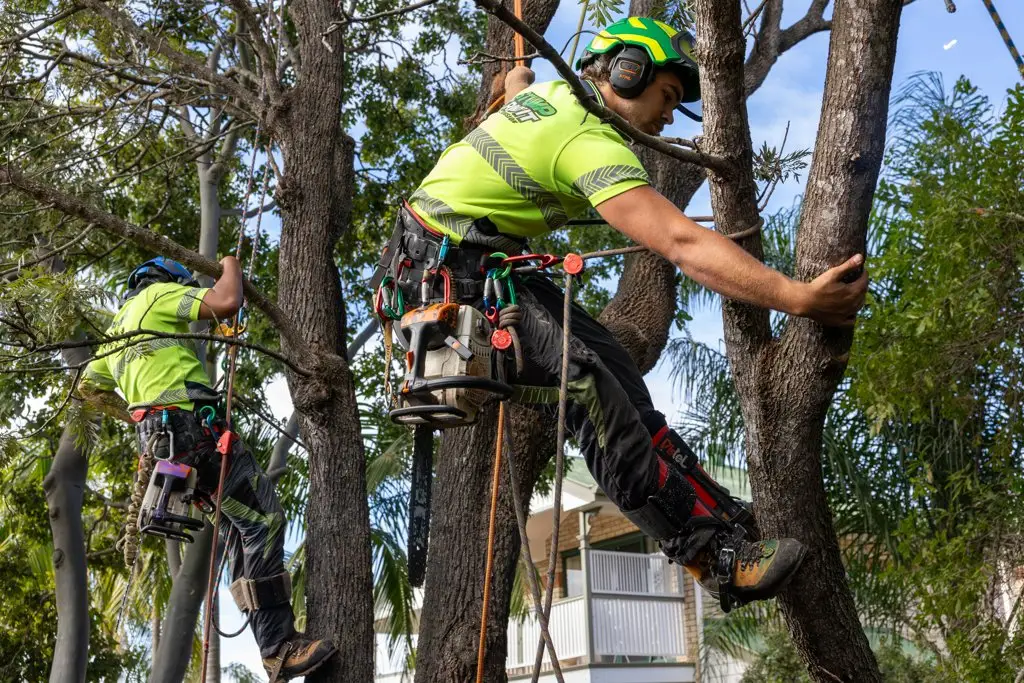
Tree pruning, and why it beats waiting for something to drop
Pruning keeps a tree in shape for the space it's actually got. On most Brisbane blocks that space is tight. Roof, fence, driveway, pool, powerline, the neighbour's carport. The tree doesn't know about any of it. Our job is to make the cuts that keep it healthy and keep everything underneath it safe.
We prune the lot. Small ornamentals in a back yard, street-facing poincianas, mature gums over a strata car park, lilly pilly hedges that have gone well past the point of a hedge trimmer. The jobs we get asked for most are deadwooding (taking out the dead limbs), crown thinning (opening the canopy so wind can move through it), crown lifting (raising the lower branches to clear a driveway, roof or footpath), and cutting back limbs that overhang a neighbour's fence.
Who calls us: homeowners who've noticed something sitting over the back deck, body corporates and strata managers with common-property trees on a maintenance cycle, property managers doing a tidy-up between tenants, builders who need clearance before a slab goes down. Strata and body corporate work is where this business started out in the Kenmore area, and it's still a big part of our week. If you sit on a committee you already know the drill. You need a quote you can put in front of owners, a date the residents can be told about, and a crew that leaves the place clean.
We work across the western suburbs around Kenmore and Chapel Hill, the river blocks through St Lucia and Indooroopilly, and across Greater Brisbane from Holland Park out to Eight Mile Plains.
One thing happens before any price gets talked about. We check whether the tree is protected vegetation. Brisbane has rules about what can be cut, and plenty of newer estates carry their own conditions in the covenant or the plan of development. Better to find that out standing under the tree than halfway through a Tuesday.
What you notice, and what's actually going on
Nearly every call starts with a symptom. Here's what we hear most, and what usually sits behind it.
Dead limbs up high. Grey and bare while the rest of the tree is green. Gums shed limbs, so a bit of deadwood is normal. It stops being normal when the limb sits over a driveway, a path or a bedroom roof, because dead timber lets go with no warning at all. A long dry stretch followed by a big drink of rain makes it worse.
Branches on the roof and in the gutters. This is the classic on the older suburbs. Houses from the 50s through the 70s got trees planted close in, and those trees are now 12 to 18 metres tall. Leaves pack the gutters out, limbs rub tiles loose in the wind, and possums use the branch as a ramp onto the roof. A crown lift or a clearance prune sorts it without wrecking the shape of the tree.
The canopy has gone thick and heavy. Our storms arrive fast between November and March. A dense canopy catches wind like a sail. Put that on top of soil that's been saturated for three days and the whole root plate can start to move. Thinning the crown takes some of that load out and lets air through.
A mess of skinny regrowth off old cuts. If a tree was topped years ago, it answers by throwing up dozens of fast shoots around the wound. Those shoots are weakly attached. They tear out in the first decent blow. We see plenty of it on camphor laurels, leopard trees and figs. The fix is a proper reduction back to a suitable lateral, not another flat top.
Limbs over the neighbour's fence. Usually it's leaves in their pool or shade over their veggie patch. Sometimes it's a limb sitting above their shed. You can generally deal with what comes onto your side, but the tree still needs the right cuts, and access often works better from their yard. We'll knock on the door and organise that.
Palms that have turned into a hazard. Golden canes clump up and shade out everything near them. Royal palms and cocos drop fronds and seed heads from height onto paths and cars. A palm clean is a different job to a removal, and it's usually the cheaper answer. We'll tell you which one your palm needs.
Clearance on common property. Low branches over a visitor bay, canopy blocking a security light or a camera, foliage hard against a unit window. Strata jobs through Taringa, Indooroopilly and Carindale often come down to millimetres of clearance and a crew that can work around parked cars.
Underneath all of it sits one local fact: subtropical growth rates. Trees here put on serious length over a wet summer. A tree that was pruned well three years back can easily be due for another look now.
How a pruning job runs with us
No surprises, no crew turning up unannounced. This is what you'll see from the first call to the last rake.
You ring, and a person answers. Bianca runs the office and is usually the first voice you get on 0421 484 940. Tell her what the tree is doing, roughly how tall it is, and where it sits on the block. Photos by text or email help a lot at this point.
We come and look at the tree. We don't quote pruning off a photo alone, because the things that drive the job are the things a photo hides. Truck access, gate width, whether limbs have to come over a pool or a colorbond fence, how far the chipper has to sit from the drop zone. While we're there we check the tree's condition, the branch attachments, the deadwood, and whether it's protected vegetation.
You get a written quote with the scope spelled out. What we're cutting, what we're not, and what happens to the waste. If a permit or a council application is needed, it's on the quote before you sign anything. If we think a prune won't fix your problem and the honest answer is a removal or a different bit of work, we'll say so.
We sort the approvals and the notice. Where a permit applies, we handle the paperwork. On strata and body corporate jobs we help with the resident notice, so nobody wakes up to a chipper outside their bedroom window. If we need access from a neighbour, we ask first. If your strata manager needs documentation before the job goes in the diary, ask and we'll send it through.
Work day starts with a set-up, not a cut. The crew walks the site, runs through the plan and the hazards, then sets the drop zone out with cones and tape. Cars get moved before the gear comes out, not after. If the job touches a footpath or the street, pedestrian and traffic control goes in first.
Then we climb, or we bring the EWP. An EWP is an elevating work platform, a cherry picker. It's the better call on sloping blocks, over pools, or where the structure of the tree isn't sound enough to climb. Where access is tight, a climber goes up on rope instead. Bigger limbs get rigged and lowered rather than dropped, which is how a fence, a roof and a garden bed all stay in one piece.
The cuts get made properly. Back to the branch collar or to a suitable lateral, sized to the branch, with no tearing of the bark. We work to the Australian standard for pruning amenity trees, and we don't top trees. A prune that looks brutal on the day is a prune that causes problems in two years.
Clean-up, then a walk around together. Green waste goes through the chipper and off in the truck. The crew rakes the site, blows down the paths and the driveway, and puts back anything we moved. If you'd rather keep the mulch for your garden beds, tell us on the day and we'll leave a pile.
Invoice after the job. Strata and body corporate clients get the documentation their manager needs for the file.
Gear, standards and the paperwork
Pruning gear is only half the story. The other half is knowing which cut to make.
Our crews carry climbing rope, harnesses, friction devices and rigging gear that gets checked before it goes on the truck. Damaged gear gets binned, not taped up. Saws run from hand saws and pole saws for fine work up to the bigger chainsaws for structural limbs, and they're kept sharp, because a sharp saw makes a clean cut and a clean cut heals. The chipper handles green waste on site, so we're not doing twelve trips to the tip past your driveway.
The EWP earns its keep on Brisbane blocks that fall away at the back. Tarragindi, Camp Hill and Fig Tree Pocket are full of them. A machine that puts the operator on a stable platform beside the limb beats working off a rope in an awkward position, and it's safer over pools, retaining walls and glass.
On standards, these are the ones that matter for this work:
- AS 4373-2007, Pruning of amenity trees. The Australian standard for how cuts are made and what each pruning type actually means. Crown thinning, crown lifting and crown reduction all have definitions in it. Topping isn't one of them.
- AS 4970-2009, Protection of trees on development sites. This one applies when there's building work near a tree that has to stay, including root zones and protective fencing.
- Work Health and Safety Act 2011 (Qld). Covers site set-up, the exclusion zone, PPE and the plant we bring on site.
- Queensland's electrical safety rules. There are exclusion zones around live powerlines that an ordinary crew can't work inside. If your tree sits in one, we'll say so at the quote and arrange the authorised line crew separately. That gets made clear from the start, not sprung on you later.
PPE isn't optional on our sites. Helmets, eye and hearing protection, cut-resistant leg protection for anyone on a saw. The crew is trained and the training keeps going, which is one of the reasons Troy bought this business and kept building it.
Storm damage and urgent pruning
Not every pruning job can wait three weeks for a booking. A cracked limb hanging in the canopy is a different conversation.
We're a working crew, not a 24-hour call centre, so we won't pretend the phone gets answered at 2am. What we do is triage. Ring 0421 484 940 and tell us what's hanging and what's underneath it. If there's a limb over a bedroom, over a driveway you need to use, over a public footpath or a common-property entry, that job goes to the front of the queue and we'll get there as fast as the run allows. Storm season gets busy. We'd rather be straight with you about timing than promise a truck that isn't free.
While you're waiting, keep everyone out from under it. Park the cars somewhere else. Don't try to pull a hung-up limb down with a rope and a ute, because limbs under tension move in directions people don't expect. If a limb is on a powerline, or a line is down, stay well clear and call the network provider or 000. We can't touch it until they've made it safe, and neither can you.
For strata and building managers, after-storm work usually runs in two parts. We make it safe first and take photos, then quote the remedial pruning for the rest of the tree once the immediate hazard is gone. That keeps the emergency job and the maintenance job separate on your books.
Why people book the Acclaim crew
We do tree work in this part of Brisbane. Acclaim Tree Care is family-run under Troy Moncur, with qualified arborists and trained staff on the trucks.
Our Google reviews say the same thing again and again. The words that come up most are professional and careful, with plenty of mentions of a tidy site and upfront pricing. That's the standard we want on every street we park on.
What arborist tree pruning looks like on your job:
- A qualified arborist assesses the tree, not a bloke with a ladder and a quote pad.
- We check protected vegetation rules before we quote, so you know where you stand with council.
- Pricing gets explained. Size, access and the volume of waste drive it, and you'll know what's included before you say yes.
- We talk to neighbours and residents when a job needs their cooperation.
- The site gets raked and the green waste gets chipped and carted. Every time.
- Body corporate and strata work has been our bread and butter since the Kenmore days, so the scheduling and documentation side is nothing new.
If a tree on your place is overhanging something it shouldn't, dropping deadwood, or just due for a proper look, ring us on 0421 484 940 and we'll book a site visit. Send photos to get started if that's easier. We cover Kenmore and Fig Tree Pocket through to Upper Mount Gravatt and Carindale.
Frequently asked questions
What does tree pruning cost?
It comes down to the size of the tree, the access to it and how much waste comes out. A tree over a pool with a narrow side gate is a different job to the same tree on an open block. We won't guess over email. Ring 0421 484 940 and we'll quote after a look at the tree.
When is the best time to prune?
For most trees, late winter into early spring works well. Flowering species like jacarandas are better pruned once they've finished flowering. Dead or hanging limbs are the exception: those come off whenever we spot them, because that's a safety issue, not a timing one.
Do I need council approval to prune my tree?
Sometimes. Brisbane has protected vegetation rules, and some trees are covered by a local law or an estate condition on the title. We check before we quote and tell you what's needed. If a permit is required, you'll hear it from us up front, not after we've started.
Can you prune branches hanging over my neighbour's yard?
Yes, and we'll talk to the neighbours first if we need access from their side. A bit of notice sorts most of it. We keep the noise, the mess and the truck off their property, and the site gets cleaned on both sides of the fence.
What happens to the branches and leaves afterwards?
We chip the lot and cart it away. The crew rakes the site and blows down the paths and driveway before we leave. If you'd like mulch left for your garden beds, just tell us on the day and we'll drop a pile where you want it.
Will you climb the tree or use a cherry picker?
Depends on the tree and the block. An EWP, or elevating work platform, is the better option over pools, on steep ground and where the tree's structure isn't sound enough to climb. Where access is too tight for a machine, a climber goes up on rope. We work that out at the quote.
How often should a tree be pruned?
Most established trees in Brisbane suit a look every two to four years. Growth rates here are quick after a wet summer, so a tree pruned well three years ago can be due again. Strata and body corporate trees usually run on a set maintenance cycle, which is easier to budget for.
Do you do storm work and hanging limbs?
Yes. We're not a 24-hour call centre, so we won't claim a truck at 2am. Ring 0421 484 940 and tell us what's hanging and what's underneath it. Limbs over bedrooms, driveways, footpaths and common-property entries go to the front of the queue.
Ready to get started?
4.9 from 114 Google reviews. Fully Insured.