
Stump Grinding
Stump grinding removes the stump and surface roots left behind after a tree comes down.
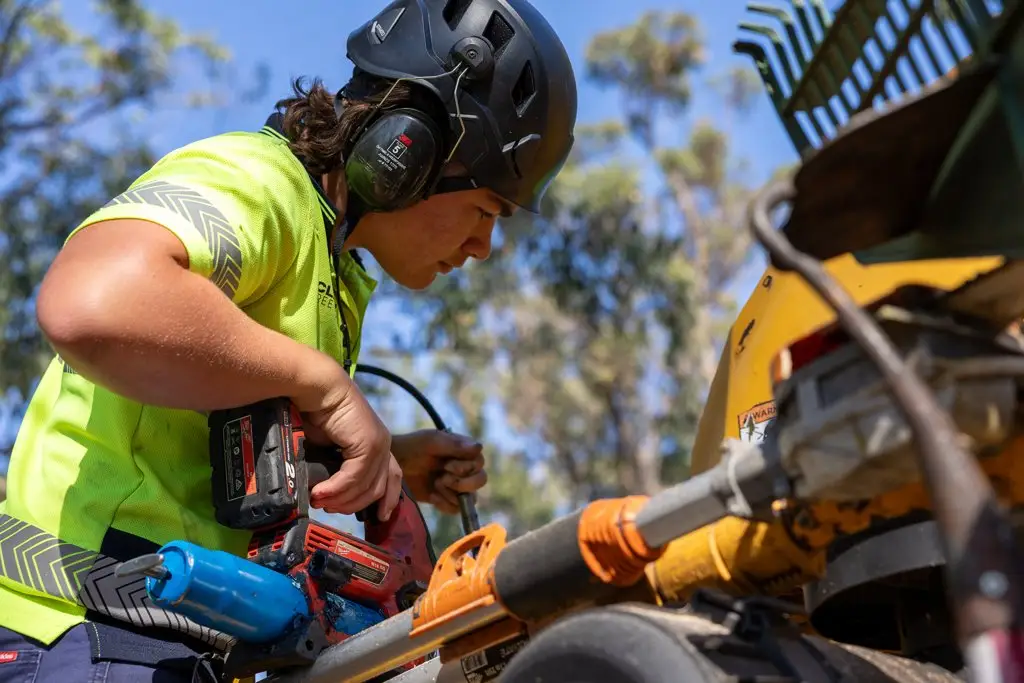
What stump grinding is, and who books it
Stump grinding is the last step of a tree removal, and it's the one people forget to book. The tree comes down, the trunk gets cut low, and you're left with a stump and a plate of surface roots sitting in the middle of the yard. A grinder sorts that out. The machine spins a steel wheel fitted with carbide teeth and sweeps it across the timber in passes. The stump comes away as chip. We take it 100 to 200mm below ground level as standard, deeper on request, which suits turf, garden beds and most fence lines.
Worth saying what grinding is not. It isn't a full excavation. We take out the stump, the root flare and the surface roots around it, not every root running under the yard. Deeper structural roots are left in the ground to rot down on their own, which is fine under turf and beds. If you're pouring footings or putting a pool in that exact spot, tell us early, because that's a different job with an excavator.
Homeowners ring us for ordinary reasons. The mower catches the same lump every fortnight. The kids trip over it. A shed, a pool fence or a slab is going in and the stump sits right where the corner lands. Plenty of people just want the back yard looking finished after a big removal.
Strata managers and body corporates book it for a different reason, and usually with more urgency. A stump on common property is a trip hazard in a shared walkway or a garden bed residents cut through. Once it's been raised at a committee meeting it needs to come off the list, with a paper trail behind it. We do a lot of that work. Acclaim was built on body corporate and strata clients, and grinding is one of the jobs we get called back for.
We work across most of Greater Brisbane. Old removals on the sloping blocks around Chapel Hill and Kenmore. Camphor laurel and fig stumps in the older streets of Holland Park and Tarragindi. Townhouse complexes through Upper Mount Gravatt and Eight Mile Plains, where the stump is usually behind a locked gate with about a metre of clearance. Different suburbs, same three questions every time: can the machine get in, how deep does it need to go, and who's taking the mulch.
What you notice, and what's actually causing it
A cut stump is not a dead stump. Camphor laurel, Chinese elm, privet, poinciana and a few of the gums will push shoots out of the collar and the surface roots for years. The root system is still alive, and those shoots keep feeding it. Mowing the suckers off knocks them back for a month, then they're back again. Grinding out the stump and the main root flare is what stops the cycle.
The second thing people notice is what moves into the timber. A hardwood stump sitting in warm, wet ground is food. Borers get in, ants get in, and pest inspectors regularly flag an old stump sitting close to a timber-framed house. We're arborists, not pest controllers, so we won't make promises about what is or isn't living in your walls. What we can say is that grinding the stump takes the food source out of the yard.
Then there's the slow collapse. Decay fungi work through a stump and its root plate from the inside out. You'll see brackets or mushrooms around the base after a wet summer, the timber goes spongy, and a few years later the ground drops. That's why lawns over old removals end up with soft dips you can feel through your boots. Same story under pavers and edging: the roots shrink as they rot, the ground settles, and the path cracks along the line of the old root.
Surface roots are the other half of the problem. On fig, poinciana and camphor laurel the roots run out wide and sit just under the grass, so the mower scalps them every pass and the turf never knits. Grinding the flare and chasing those roots back is what gives you a flat surface to work with.
So why are there so many stumps across our patch? Storm season, mostly. November through March puts trees on the ground all over Brisbane, and an emergency crew's job that night is to make the site safe, not to finish your yard. Renovations do the rest. A pool going in, a new shed, a fence line, a granny flat out the back. A fair few stumps also come from a previous owner or a cheap crew who cut the tree, took the money and left a knee-high stump behind because their machine wouldn't fit down the side.
Timber matters more than people expect. Spotted gum, ironbark and blue gum can sit in our clay for years and barely soften. Camphor laurel goes stringy and holds together. Palms are different again: cocos and royal palm stumps are wet and fibrous, they rot from the top down, and the root ball underneath stays solid enough to stop a mower dead. The species changes how long a grind takes, so it's one of the first things we ask about on the phone.
How we run a stump grind, from first call to clean site
The first call goes to Bianca in the office. She'll ask how many stumps, roughly how wide across at ground level, what the tree was if you know it, what's going in the space afterwards, and how wide the side access is. Photos by text or email help more than any description. For a single front-yard stump with a clear run from the street, that's often enough for us to quote.
Anything tighter and we'll come and look. On site we measure the widest point at ground level, the flare rather than the cut face, then measure the gate, check the slope and work out the route for the machine. We look for retaining walls, pool fences, glass balustrades, septic tanks and irrigation lines. And we ask where your services run. Water, power, comms, gas, pool plumbing and sewer all sit at grinding depth in some yards, so we pull plans through Before You Dig Australia and use a locator where there's real doubt. If a service runs straight under the stump we'll hand dig around it or hold the depth back on that side. You'll hear that before we start, not after.
Then you get a written quote. It names the number of stumps, the depth, whether surface roots are included, whether the chip stays or goes, and any access note that matters. For strata we set the quote up so it can drop straight into a committee pack, in plain English, with the scope and the exclusions where the committee can see them.
Once it's approved we book a day and sort out access. That means gate keys, a car moved off the driveway, a note for the noticeboard and a call to the building manager. Residents get told what's happening and roughly how long we'll be noisy. Neighbours get the same courtesy where the machine has to work on a boundary.
On the day the crew runs a short toolbox talk, sets an exclusion zone and gets the PPE on. Before the grinder starts we clear the area: rocks, bricks, edging, sprinkler heads, the kids' gear. A grinder throws anything it finds. Where chip could reach a window, a car or a pool fence we stand mesh or ply shields, and we lay boards where the machine has to cross soft turf.
The grind itself is patient work. The wheel comes in at the face of the stump, sweeps side to side, drops a little on each pass and works its way down. We check the depth as we go, then chase the surface roots out from the flare, usually 300 to 500mm, further if you're re-turfing or paving. A standard suburban stump is done well inside an hour. A big fig or a camphor with a metre of flare and a tangle of roots can take most of a morning.
When the timber's gone you're left with a mound of chip. Most people use it to backfill the hole. It settles over the first few weeks, so we mound it proud and you top it with soil once it drops. If you'd rather it gone, we barrow it out and take it with us. That's the usual call for strata, and for anyone laying turf straight away. Then we rake, blow the paths and driveway down and hose off where it's needed. Strata jobs get before and after photos for the records, and the invoice comes from the office.
One honest note about the day. Buried surprises change a grind: old concrete, rubble fill, a star picket, wire fencing grown through the trunk, or a rock shelf a hand-width down. That gear wrecks carbide teeth and slows everything up. We'd much rather find it at the quote stage, which is another good reason we walk the site first.
Machines, checks and the standards we work to
We run more than one size of grinder because our patch demands it. A narrow self-propelled machine fits through a standard side gate of about 750mm, and that's what gets us into the back yards of Holland Park, Tarragindi and half the townhouse complexes across Brisbane. Bigger towed and tracked machines go on open front yards, acreage blocks and the larger jobs around Carindale. Where nothing will fit, and that does happen on the steep Brisbane blocks, we'll tell you at the quote and talk through hand work or a different approach. You won't get a crew turning up and shrugging at your gate.
Teeth do the work. Carbide teeth get checked and swapped as they wear, because blunt teeth mean a slow job, a rough finish and a lot more vibration through the machine and the operator. The crew runs a pre-start check every morning: guards, chip deflector, hydraulics, fuel, teeth, tracks and tyres. The rest of the kit travels with us. Chainsaw, blower, barrows, tarps, ramps and boards.
Chip volume surprises people. A stump a bit wider than a dinner plate can fill a couple of barrows once it's ground out, and a big camphor will fill a solid part of a truck. That's why we ask up front whether the mulch stays or goes. It changes the gear we bring and the time we spend on site.
The standards are simple enough to explain. Where we're grinding near a tree you're keeping, we work to AS 4970-2009 Protection of trees on development sites, which sets out tree protection zones and keeps the machine off the roots holding that tree up. Any pruning we do alongside the grind follows AS 4373-2007 Pruning of amenity trees. On strata and commercial sites we work to a safe work method statement under Queensland workplace health and safety rules, and we keep the machine and the crew clear of overhead service lines and to the electrical exclusion distances.
PPE goes on at every site: helmets, mesh visors with safety glasses underneath, hearing protection and high-vis. Grinding throws grit and chip constantly, so eye and face protection isn't optional, even on a ten minute job. Our crews are qualified arborists and trained staff, and the training keeps going. That's how Troy runs the business.
Urgent stumps and storm work
A stump is not the same kind of emergency as a limb hanging over a bedroom. Nobody should be running a grinder in the dark, and we won't advertise a 24-hour stump service we can't sensibly deliver.
Some stump jobs genuinely can't wait, though. A storm removal that's left a stump in a driveway or across a shared path. A trip hazard on common property that's been written up in a safety report and has to be closed out. A settlement or handover date. A concreter or fencing crew booked for Monday morning who can't start with a stump in the way. Ring us and say so. We hold room in the run for short-notice work, and if we can't get to you this week you'll hear that straight away instead of a week of silence.
Storm season is the busy stretch. After a big blow through Indooroopilly and the western suburbs, the crew triages the calls: trees on houses and blocked access first, then removals, then grinding once the sites are safe. The grind follows the removal. We're not putting you off. Safe sites come first, and the yard gets finished properly after.
If the hazard needs managing in the meantime, ask us. We can cut a stump flush, cone and tape it, or mound mulch over it so residents can see it until the machine gets there. For a body corporate that's often enough to answer the report while the work gets scheduled properly.
The office line is 0421 484 940 during work hours. After hours, leave a message and we'll ring you back.
Why people call the Acclaim crew
The same three things come up over and over in our Google reviews. The crew turns up when we said we would. The work gets done the way it was explained. And the site is left clean. That last one gets mentioned more than anything else, which tells you what people actually care about once the noise stops.
Clean-up is where most of the complaints about tree crews come from, so we treat it as part of the job rather than a favour. Paths blown down, driveway clear, the neighbour's side checked as well as yours. If we've had to set up on the street, the cones and the signage leave with us.
Acclaim is family-run under Troy Moncur, with Bianca on the phones. Qualified arborists, trained staff, and a focus on safety and ongoing training. The business grew up on body corporate and strata work, so we know what a committee needs from a quote: clear scope, clear exclusions, notice for residents, photos for the records and an invoice that matches what was approved.
On price, we're upfront. We won't guess a figure over email, because stump size, timber, access, depth and what happens to the chip all change it. Once we've seen the job you get a written quote that says exactly what we'll do.
That's what you get with arborist stump grinding rather than a hire machine and a lost weekend. The crew running the grinder can tell you whether those surface roots belong to a tree you're keeping, whether grinding that close will unsettle it, and where the protected vegetation rules sit. Grinding the stump of a tree that's already gone is generally fine, since the protection rules apply to removing the living tree. If there's any doubt about the tree or the site, we check before anything starts.
Got a stump you want gone? Ring the crew on 0421 484 940 or send a couple of photos through acclaimtreecare.com.au, and we'll tell you what it takes to get that ground back.
Frequently asked questions
How does stump grinding work?
A stump grinder cuts the stump into chip with a steel wheel of carbide teeth that sweeps side to side across the timber. The operator takes a few centimetres per pass, works down until the stump sits 100 to 200mm below ground level, deeper on request, then chases the surface roots out from the flare. Most single suburban stumps take 30 to 90 minutes on site, including set-up and clean-up. Stump width, timber type and how far the machine has to travel across your block move that either way. A big fig or camphor laurel in the older streets of Holland Park or Tarragindi can take most of a morning.
How deep do you grind the stump?
Usually 100 to 200mm below ground level, deeper on request, which suits turf and garden beds. If you're pouring concrete, building over the spot or planting another tree in the same hole, tell us when you book and we'll go deeper and wider. Depth changes the time on site, so it belongs in the quote rather than being sprung on the crew on the day.
What happens to the hole and the mulch?
Grinding leaves a mound of wood chip, and most people use it to backfill the hole. It settles over the first few weeks, so we mound it proud and you top it with soil once it drops. If you'd rather it gone, we'll load it out and take it with us. Just let us know when you book, because it changes the gear we bring.
Can you get a stump grinder into a backyard?
Often yes. Our smaller self-propelled grinders fit through a standard side gate of about 750mm, which covers most back yards across Brisbane. Tight access, stairs, a steep slope or a narrow path can change the approach, so we look at the site before the work day and tell you straight what's possible.
What does stump grinding cost?
It depends on the stump size, the timber, how close it sits to fences and pipes, how deep you need it, and how far the machine has to travel across your property. We won't guess a figure over email. Ring the crew on 0421 484 940, we'll ask a few questions or come and look, and you'll get a written quote.
Do I need council approval to grind a stump?
Grinding a stump from a tree that's already gone is generally fine. Protected vegetation rules in Brisbane apply to removing the living tree, not the leftover stump. If you're unsure about the tree, the site or a nearby tree you're keeping, we'll check before anything starts.
Can I lay turf or plant a new tree where the stump was?
Yes, with a bit of prep. Wood chip draws nitrogen as it breaks down, so for turf or new plants it's better to dig the chip out of the hole and backfill with soil. For a replacement tree in the same spot, tell us at quote stage so we grind deeper and wider and take more of the root plate out.
Do you grind the surface roots as well as the stump?
Surface roots within about 300 to 500mm of the flare are normally part of the job, and we'll go further out if you're re-turfing or paving. Deeper structural roots stay in the ground and rot down on their own. Roots running under a path, driveway or slab need a look first, because grinding there can undermine what's sitting on top.
Ready to get started?
4.9 from 114 Google reviews. Fully Insured.